
I Asked ChatGPT to Evaluate How I Use AI

What I learned about Chat Work and Codex while keeping the human in the loop
By Dr. Muhsinah Morris, Dr. M.O.M., Molder of Minds
A colleague recently mentioned that humans can become the bottleneck in a Codex workflow. That observation stayed with me because I could see how it might apply to my own interactions with AI more broadly.
I use these tools to think, write, teach, create, and move ideas toward something people can actually use. Yet I still found myself asking a familiar question: Why am I doing so much of the coordinating?
So I asked ChatGPT to look at how I was working.
There is something humbling about teaching emerging technologies and then typing, “I don't think that I use Codex well.” But expertise should leave room for self-examination. I am Dr. M.O.M., the Molder of Minds. My own mind remains on the syllabus.
The experience helped me put words to a distinction I want more people to understand: a human can remain meaningfully involved without personally directing every small step.
The question that started this conversation
Here is the question I actually asked:
I don't think that I use Codex well, and I want to know if you can evaluate the way that my patterns of interacting with Codex, ChatGPT, Chat and work could be elevated so that I could be more productive, but that I actually get the things done that need to be done simultaneously and use the right workflow.
It was conversational. It was imperfect. It was specific about the outcome I wanted: more work finished, with a workflow suited to how I actually operate.
The response opened with an assessment that felt particularly useful:
“My assessment is that you use AI effectively for thinking and creating, but you still carry too much of the coordination required to finish the work.”
That is feedback from my conversation, not a scientific measurement of my productivity. The assistant also acknowledged that it could not see a complete activity log or determine what I had finished outside the available conversations. That qualification matters. An AI-generated reflection can help us investigate a pattern without becoming the final authority on our behavior.
Understanding Chat Work and Codex
I initially described them as three separate products. A more useful description is three experiences within the broader ChatGPT ecosystem, with overlapping capabilities. OpenAI presents Chat for conversation and exploration, Work for turning goals and source material into deliverables, and Codex for software development. OpenAI, ChatGPT Learn
Here is how I would apply those distinctions to my own work:
Chat
I need to clarify my thinking.
Example assignment: Help me examine the argument that humans can slow down AI workflows while remaining essential to their quality.

Work
I need a usable set of materials.
Example assignment: Turn my approved argument and sources into an article, platform-specific posts, and a coordinated visual brief.

Codex
I need functioning software.
Example assignment: Implement one defined interaction in an educational application, test it, and show me the result.

These are starting points, not exclusive boundaries or a sequence every task must follow. I do not need to turn a straightforward writing assignment into a tour of every mode.
My first question can be simple: What do I need in my hands when this is finished?
If I need a clearer position, I can begin with a conversation. If I already know the position and need the materials, I can delegate production. If I need software that performs a task, the request needs implementation and testing.
What the feedback noticed about me
The assistant recognized that I give detailed direction about audience, identity, tone, and visual representation. That is true of this very article's illustrations. I know how I want to be represented, and I know that representation communicates something to my audience.
It also identified friction in the later stages of my work. Presentations had needed changes to typography and color. A deck had been difficult to download. Articles became social posts through separate follow-up requests.
Those examples helped me see where an initial request could carry more of the assignment. For a presentation, I can specify that completion includes an editable file, readable slides, verified references, and a usable delivery link. For an article, I can request the associated posts at the beginning, when I already know I will need them.
The assistant described the issue this way:
“My inference is that the largest bottleneck is the handoff between ‘created’ and ‘finished.’”
I appreciate the word “inference.” It leaves room for me to agree, disagree, and examine the evidence.
One of its most useful examples came from my community responsibilities. In a request about our baseball team's schedule, I had named the information source, the destination, and the point where I wanted to review the message before it was posted. That was a clear assignment. The same approach could serve a faculty workshop or a business deliverable.
There was also a line that I think every AI user should hear:
“Some of that responsibility belongs to the assistant: you should not have to repeatedly ask it to complete work you already authorized.”
That keeps this discussion honest. A poorly designed interface, a missing connection, an inaccessible file, or an assistant that stops too early can also slow the work. I will examine my own habits without accepting responsibility for every limitation of the system.
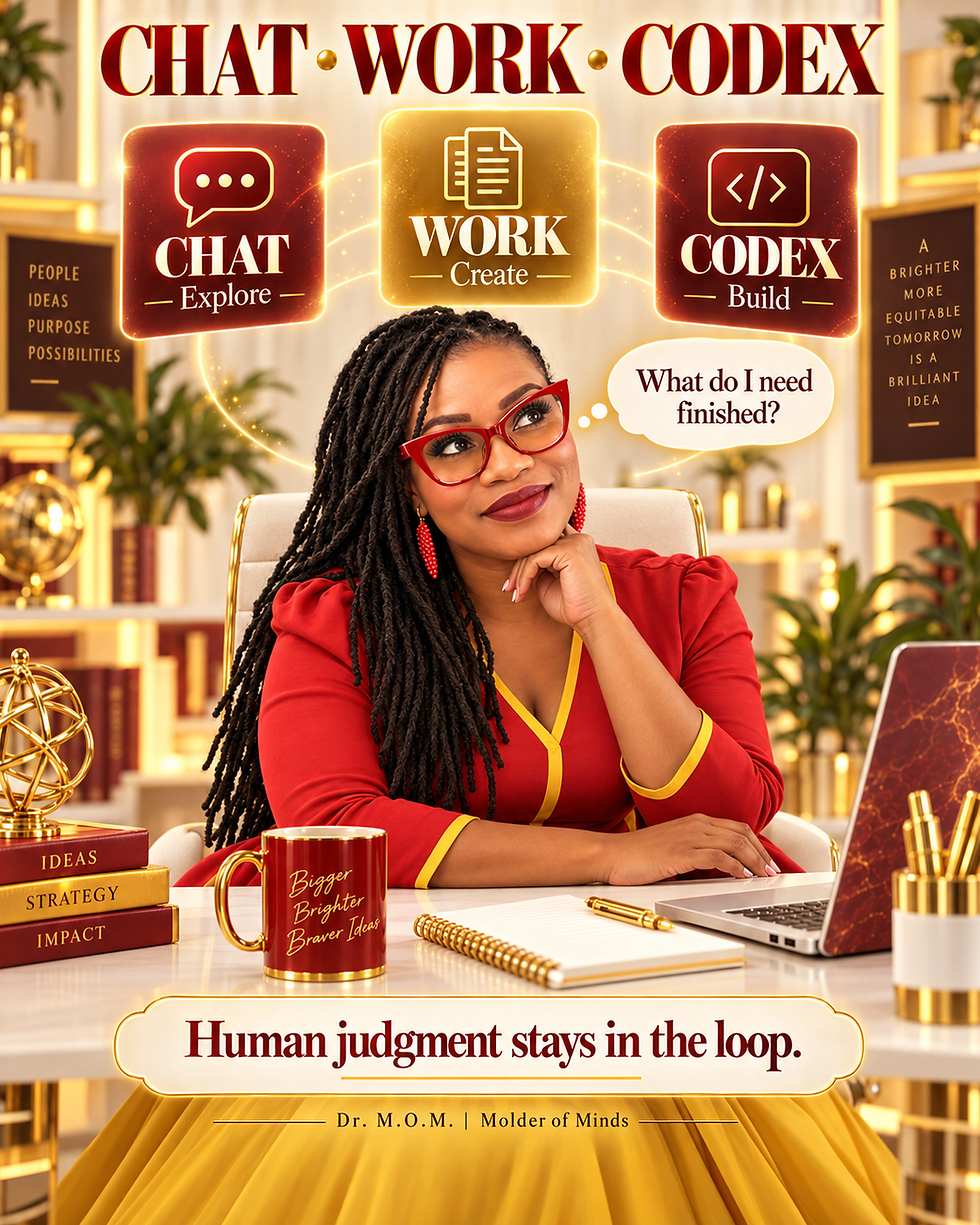
The human still belongs in the loop
I am a proponent of human involvement. My goal is to make that involvement purposeful.
I want to decide what matters, whom the work serves, which claims are justified, and whether the result represents my voice. I want to examine how students or other users may be affected. I want authority over what is published in my name.
I do not need to retype an instruction that was already clear or personally move every paragraph between formats.
For me, this is a question of where judgment belongs. I would organize an assignment around three moments of human attention: setting the direction, resolving decisions that materially change the work, and reviewing the finished result before consequential use.
In education, that final review has substance. Does the explanation teach the intended concept? Do the sources support the claims? Are the materials accessible to the learners I am trying to reach? A beautiful output can still need correction.
This is my proposed way of working. I am not claiming that I have already measured its effect on my productivity.
How I would handle simultaneous work
I want useful progress on multiple obligations without creating multiple unfinished assignments that all require my attention at once.
For a speaking engagement, checking event details and exploring a visual direction can be separate activities. Final promotional copy needs confirmed details. Final slides need an agreed message and evidence. The order matters.
My recommendation is to tell the assistant which pieces are independent and ask it to identify the dependencies. Then ask for a clear status: what has started, what is finished, and what requires a decision.
I would also avoid assuming that every conversation knows the latest result of every other conversation. When work moves between tasks, I want an explicit handoff with the current source and the next expected result.
For my first experiment, I would limit the active review queue to three deliverables: one professional deadline, one business outcome, and one family or community obligation. That is a personal experiment in managing my attention, not a claim about a platform's technical limits.
A prompt you can adapt
You do not need my job, my projects, or my vocabulary to ask for this kind of reflection. Here is an expanded version of my question:
Evaluate how I use ChatGPT, including Chat, Work, and Codex where available. Use only the conversation history, examples, and connected information you can actually access, and tell me what you cannot see.
Identify patterns that help me finish work and patterns that create unnecessary revisions, coordination, or unfinished handoffs. Support your observations with specific examples. Distinguish observations from inferences, and do not treat your assessment as a psychological diagnosis or a measured productivity score.
Recommend a workflow tailored to my responsibilities and working style. Explain which experience is a useful starting point for each kind of task. Identify what can proceed independently, what depends on earlier work, and where my judgment or approval belongs. Verify current product capabilities using official sources rather than assuming I have access to every feature.
Give me three practical changes, a realistic example using one of my tasks, and a definition of done. Separate finished deliverables from anything that is merely drafted, proposed, scheduled, or blocked. If you lack enough context, ask me for a few representative examples. Do not invent my history or publish anything as part of this evaluation.
If the tool has little relevant context, provide a small sample of your own requests and their outcomes. Include one that worked well and one that required too much back-and-forth. Avoid including other people's private information unnecessarily.
When you receive the response, challenge it. Ask which examples support the conclusion. Correct anything it has misunderstood. The reflection becomes useful through your judgment.
What I want to measure next
I want to know whether the work reaches the point where I can use it. I would track three things: completed outcomes, interventions I had to make, and remaining items that need my decision.
That gives me a more meaningful question than “How many prompts did I write today?”
I started this conversation by admitting that I could use these tools better. I am sharing it because I suspect other capable, experienced people are carrying more coordination than they need to carry. That is a possibility worth examining, not a verdict on everyone's workflow.
As the Molder of Minds, I want AI literacy to include the ability to examine our own process. We can keep learning how to delegate while protecting the human judgment that gives the work its purpose.
Try the prompt. Which part of your workflow did the response help you see more clearly? Which part did it misunderstand?
Share your experience in the comments, and follow my work for practical conversations about generative AI, education, and using emerging technologies with intention.
AI transparency: I used ChatGPT to reflect on my interaction patterns and help draft this article. The quotations are excerpts from that conversation. The proposed workflow is an interpretation to test, not a measured productivity result. Product descriptions were checked against official OpenAI information on September 21, 2026.
The illustrations were generated with AI using my reference photographs. The screens are conceptual representations of the workflows.
Source: OpenAI. (n.d.). ChatGPT Learn. Retrieved September 21, 2026, from https://learn.chatgpt.com/


Comments